Sunscreen News · Alaska
Bemotrizinol: The First New FDA-Approved Sunscreen Ingredient in Over 25 Years, Explained by an Alaska Dermatologist
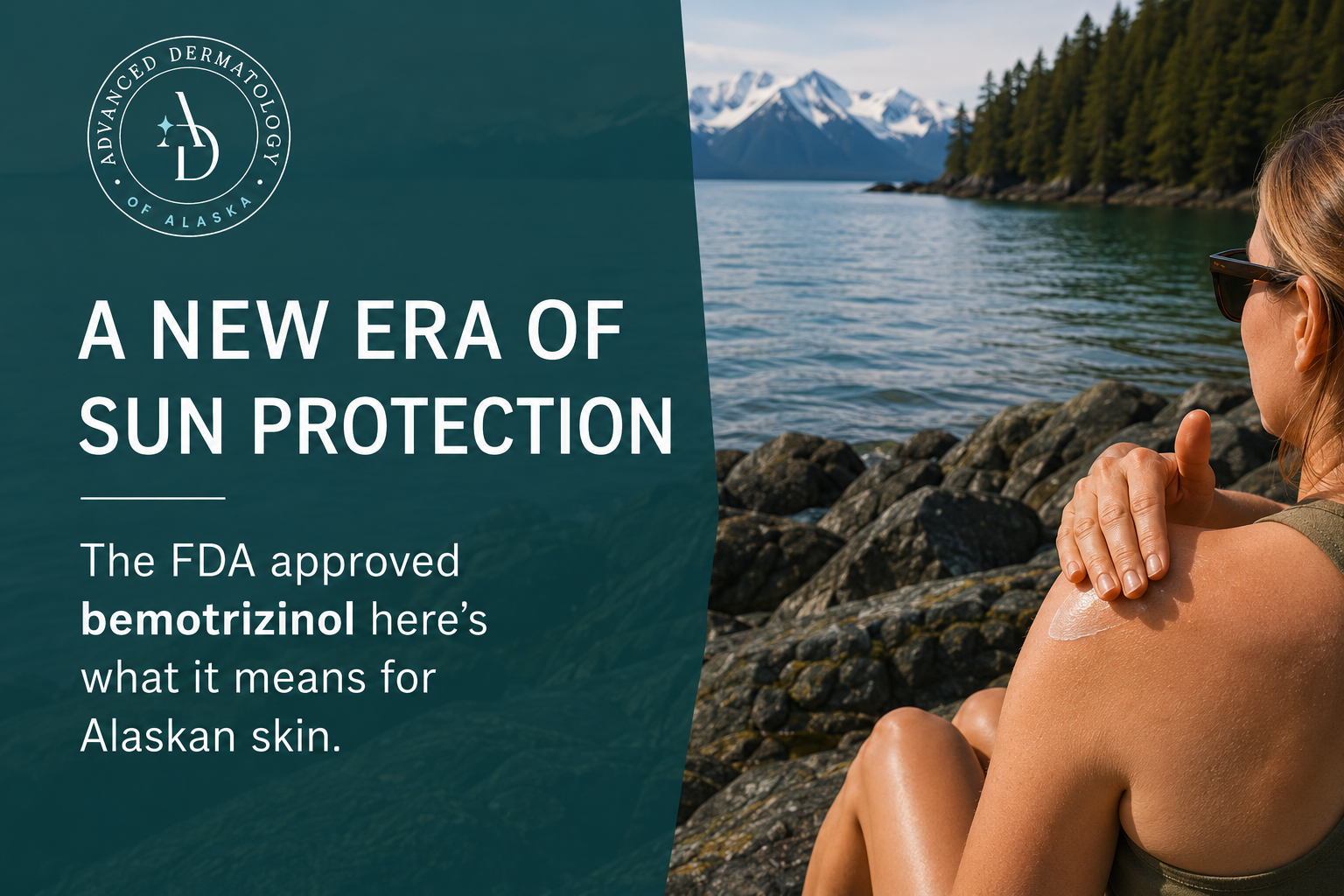
For the first time since the 1990s, the FDA has approved a new sunscreen filter. Here is what bemotrizinol is, why dermatologists are excited about it, and when Alaskans can expect to see it on store shelves.
June 15, 2026 · Medically reviewed by Blake Galler, DO, FAAD, Advanced Dermatology of Alaska · Wasilla · Anchorage · Juneau
On June 9, 2026, the U.S. Food and Drug Administration did something it had not done in more than 25 years: it approved a brand-new sunscreen active ingredient. The ingredient is called bemotrizinol, and if you follow skin health news you may have seen it covered by CNN, CBS, ABC, and NBC the same day. For those of us practicing dermatology in Alaska, where UV exposure is easy to underestimate, this is good news worth understanding. As far as we are aware, we are likely the first dermatology office in Alaska to write about it for patients.
Below, we walk through what bemotrizinol actually is, what its safety record looks like, why it matters for the sunscreens you will be able to buy, and the timeline for when it will reach the U.S. and Alaska markets.
What is bemotrizinol?
Bemotrizinol is an ultraviolet (UV) filter, the active component in sunscreen that absorbs or blocks the sun's harmful rays before they can damage your skin. You may also see it referred to as BEMT, or by the trade names Parsol Shield and Tinosorb S, the name it has carried in Europe and Asia for years.
It belongs to the family often described as "chemical" or organic filters, as opposed to the "mineral" filters (zinc oxide and titanium dioxide) that sit on top of the skin. But bemotrizinol stands apart from older chemical filters in a few important ways. It is broad-spectrum, meaning it covers both UVA rays (which drive premature aging and contribute to skin cancer) and UVB rays (which cause sunburn and also contribute to skin cancer). It is also highly photostable, meaning it does not break down quickly when exposed to sunlight, unlike some older filters that lose effectiveness over the course of a day outdoors.
Until now, the only widely available non-mineral filter in the U.S. that offered meaningful UVA protection was avobenzone, which has a known tendency to degrade in sunlight. Bemotrizinol fills that gap with a more durable option.
Is bemotrizinol safe?
This is the first question we ask about anything we recommend to patients, and it is a fair one. The reassuring answer is that bemotrizinol arrives in the U.S. with one of the strongest safety records of any UV filter available.
Not new to the world
Bemotrizinol has been approved and used in the European Union since 2000, and across Australia and parts of Asia for years. That means decades of real-world use behind it, not just laboratory data.
Reviewed under the FDA's modern standard
The agency determined bemotrizinol to be GRASE (Generally Recognized As Safe and Effective) and approved it for adults and children 6 months of age and older.
Stays on the skin, not in the body
Bemotrizinol is large and not easily absorbed through the skin, and experts have described it as having among the most robust safety data of any UV filter to date.
No hormonal activity
Unlike some other organic sunscreen ingredients that have raised questions, bemotrizinol has not shown estrogen-like effects in laboratory testing.
As with any sunscreen ingredient, a small number of people can have skin sensitivity or irritation, and we always encourage patients with reactive skin to patch-test a new product. But overall, the safety profile is a major part of why dermatology organizations have welcomed this approval.
Why this is good news for sunscreens, and for your skin
The most exciting part of this approval is not just one new ingredient, but what it unlocks for the next generation of sunscreens, especially mineral-based ones.
Many of our patients prefer mineral sunscreens (zinc oxide and titanium dioxide) because they are gentle and sit on top of the skin. The well-known downside is the white cast they can leave, which is more noticeable on some skin tones and is a common reason people skip reapplication. Bemotrizinol helps solve this. Because it can be blended with zinc oxide, formulators can create broad-spectrum mineral-based sunscreens that protect strongly while going on lighter and clearer, with much less of that chalky white film.
It is also highly efficient, providing strong protection at relatively low concentrations. That gives the companies who make sunscreen more room to design products that feel pleasant to wear: lightweight, comfortable, and elegant enough that people actually use them the way they should. In sun protection, the best sunscreen is ultimately the one you will apply generously and reapply without complaint, so a more wearable product is not a small thing. It directly translates to better real-world protection.
For Alaskans specifically, this matters. Our patients deal with long summer days, high-latitude and on-the-water UV, and intense snow reflection in winter that catches many people off guard. A sunscreen that is easier and more comfortable to wear year-round is a meaningful step forward for skin cancer prevention here.
When will bemotrizinol be available in the U.S. and Alaska?
Here is the timeline based on the FDA's final order:
- June 9, 2026: The FDA issued its final administrative order approving bemotrizinol for the over-the-counter sunscreen monograph.
- August 9, 2026: The order officially takes effect. On this date, sunscreen manufacturers may legally begin including bemotrizinol as an active ingredient in U.S. products.
- Late 2026: Industry sources expect the first U.S. products featuring bemotrizinol (under the Parsol Shield name) to begin reaching the market, with broader availability following into 2027.
For Alaska, products will generally arrive on the same national timeline, reaching major retailers and pharmacies as manufacturers roll out reformulated lines. We will be watching closely and will update our patients in Wasilla, Palmer, the Mat-Su Valley, Anchorage, and Juneau as specific products become available, and we are happy to help you choose one that fits your skin.
What this does not change
One important note so the headlines do not get ahead of the science. Bemotrizinol is a real advance, but it does not replace the fundamentals of sun protection that we discuss with every patient. Broad-spectrum SPF 30 or higher, applied generously and reapplied every two hours outdoors, remains the standard. Sun-protective clothing, wide-brimmed hats, UV-blocking sunglasses, and seeking shade during peak hours all still do work that no single ingredient can. And regular skin cancer screening and professional skin exams remain central to catching problems early.
Think of bemotrizinol as a better tool in an already-proven toolbox, not a reason to change the basics. If you would like to review your overall approach to protecting your skin, our guide to lowering your skin cancer risk is a good place to start.
Talk to an Alaska dermatologist about sun protection
Whether you have questions about which sunscreen is right for your skin, want a spot checked, or are due for a skin exam, our team is here to help at all three of our Alaska locations.
Frequently Asked Questions
Bemotrizinol (also called BEMT or Parsol Shield) is a broad-spectrum UV filter used in sunscreen. It protects against both UVA and UVB rays and is highly stable in sunlight. It has been used in Europe and Asia for over two decades and was approved by the FDA for the U.S. market on June 9, 2026.
Bemotrizinol has one of the strongest safety records of any sunscreen filter. The FDA approved it as Generally Recognized As Safe and Effective for adults and children 6 months and older. It is not easily absorbed into the skin and has not shown hormonal effects in laboratory testing. As with any product, people with sensitive skin should patch-test first.
Manufacturers may begin adding bemotrizinol to U.S. products starting August 9, 2026. The first products, sold under the Parsol Shield name, are expected by late 2026, with wider availability into 2027. Alaska will generally follow the national rollout.
It is a non-mineral (organic) filter. However, one of its biggest advantages is that it can be combined with mineral filters like zinc oxide to make better broad-spectrum mineral-based sunscreens with less white cast.
Not at all. Your current broad-spectrum SPF 30 or higher sunscreen remains effective and you should keep using it. Bemotrizinol simply expands the options that will be available going forward.
Medical disclaimer
This article is for general educational purposes and reflects information available at the time of writing, including the FDA's June 2026 final order. It is not medical advice and does not replace a consultation with a qualified clinician. Product availability, formulations, and labeling may change as manufacturers bring bemotrizinol-containing sunscreens to market. If you have specific concerns about sun protection, sensitive skin, or a spot that worries you, please schedule a visit with a dermatology provider.
Selected references
- U.S. Food and Drug Administration. "FDA Expands Sunscreen Options for the First Time in 20 Years." Press announcement, June 9, 2026.
- FDA Final Administrative Order OTC000039, OTC Sunscreen Monograph M020 (bemotrizinol, up to 6%), effective August 9, 2026.
- Healthline. "Bemotrizinol: What Is the 'New' FDA Approved Sunscreen Ingredient?" June 11, 2026.