
Skin Cancer · Alaska
How to Do a Skin Self-Exam: An Alaska Dermatologist's Guide to Spotting Skin Cancer Early
Ten minutes in front of a mirror could save your life. Here is exactly how to check your own skin, what a concerning spot actually looks like, and what changes with age.
June 20, 2026 · Medically reviewed by Andrew S. Dorizas, MD, Advanced Dermatology of Alaska · Wasilla · Anchorage · Juneau
Here is something worth getting excited about: skin cancer is one of the most detectable cancers there is, because the warning signs are right there on the surface where you can see them. You do not need a lab, a scan, or a needle to start catching problems early. You need a mirror, good light, about ten minutes a month, and a little know-how.
When melanoma is caught early, the five-year survival rate is around 99 percent. That is an enormous payoff for a small habit, and we want to help you build it.
This guide walks you through how to perform a skin self-exam, what concerning lesions can look like, how melanoma differs from more common non-melanoma skin cancers, and how your risk shifts at different stages of life.
Why self-exams matter, especially in Alaska
It is easy to assume skin cancer is a sunbelt problem, but that is a myth worth busting. Alaskans get meaningful UV exposure from long summer days, high-latitude and on-the-water light, and intense snow reflection in winter that catches people off guard.
Many Alaskans also spend serious time outdoors year-round. Fishing, skiing, hiking, boating, snowmachining, hunting, and working outside can all add up over time. The encouraging part is that you are your own best early-warning system, because you see your skin every day.
How to do a skin self-exam, step by step
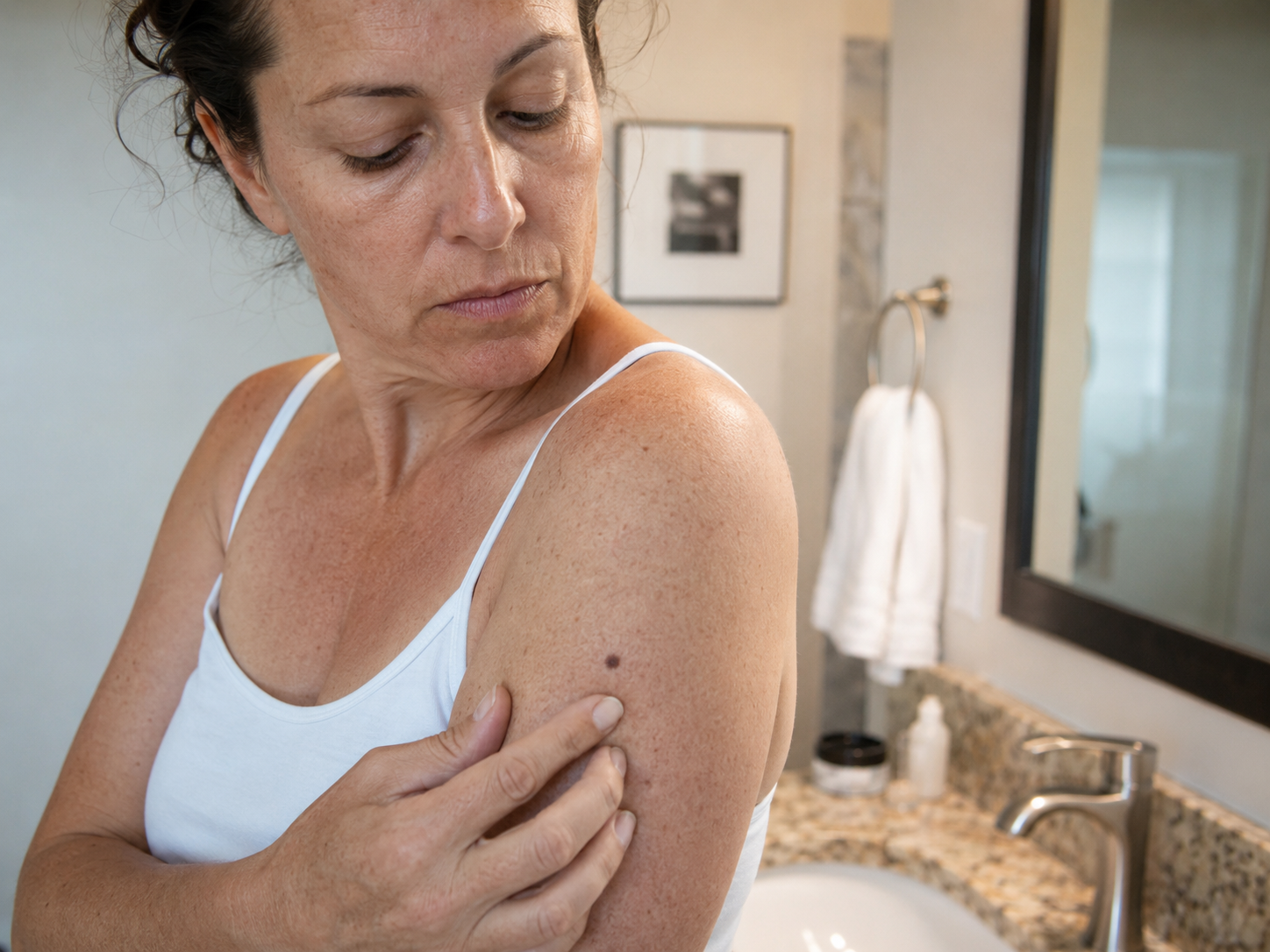
Set yourself up for success first. Pick a well-lit room, grab a full-length mirror and a hand mirror, and give yourself about ten minutes. Doing this the same day each month, such as the first day of the month, makes it a habit instead of an afterthought.
Then work through your whole body systematically so nothing gets skipped:
- Face the full-length mirror and check your face, neck, chest, and belly. Women should lift the breasts to check the skin underneath.
- Raise your arms and examine the left and right sides of your body, including the underarms.
- Look at your forearms, the tops and palms of your hands, between your fingers, and under your fingernails.
- Sit down and check the fronts of your legs, the tops of your feet, between your toes, and under your toenails. Then use the hand mirror to see the soles of your feet.
- Use the hand mirror to examine the backs of your legs, your buttocks, and the genital area.
- Finally, use both mirrors, or ask a partner, to check your back, the back of your neck, your scalp, and behind your ears. A blow dryer can help part the hair so you can see the scalp.
A helpful habit is to photograph any spot you want to follow and date the photo. Comparing pictures a couple of months apart is one of the most reliable ways to catch a spot that is changing. Change over time is one of the most important warning signs.
What melanoma looks like: the ABCDEs
Melanoma is the most serious form of skin cancer because it can spread. It is also highly treatable when caught early. To spot it, dermatologists often use a simple memory tool called the ABCDEs. Run any mole or new spot through these five checks.
A: Asymmetry
One half of the spot does not match the other half.
B: Border
The edges are irregular, ragged, notched, or blurry rather than smooth and even.
C: Color
The spot has more than one color, or uneven shades of brown, black, tan, and sometimes red, white, or blue.
D: Diameter
The spot is larger than a pencil eraser, about 6 millimeters, although melanomas can be smaller. Do not ignore a small spot that looks different.
E: Evolving
The spot is changing in size, shape, color, or elevation, or it is newly itching, bleeding, or crusting. Evolving is the most important letter.
There is one more clue worth knowing: the ugly duckling sign. Most of your moles tend to resemble one another. If one spot clearly stands out from the crowd because it is larger, darker, lighter, or simply different, that ugly duckling deserves a closer look even if it does not check every ABCDE box.
What non-melanoma skin cancers look like
Melanoma gets the headlines, but basal cell carcinoma and squamous cell carcinoma are far more common. They often look nothing like a classic suspicious mole.
These cancers often show up on sun-exposed areas such as the face, ears, scalp, neck, hands, and forearms. Watch for:
- A pearly, waxy, or translucent bump, sometimes with tiny visible blood vessels.
- A flat, scaly, reddish, or pink patch that may feel rough.
- A firm red nodule.
- A sore that bleeds, crusts, and reheals in a cycle.
- A sore or spot that will not heal, or heals and then comes back in the same place.
That last point is important. A pimple or scab that sticks around for more than a few weeks, or keeps returning to the same spot, is worth showing to a dermatologist. Non-melanoma skin cancers are rarely life-threatening when treated early, but left alone they can grow, invade deeper tissue, and become much harder to treat.
How risk changes across the stages of life
Skin cancer can develop at any age, and good sun habits matter for everyone. Your risk profile shifts as you move through life, so it helps to know what to focus on at each stage.
Younger adults
Melanoma is one of the more commonly diagnosed cancers in younger adults, and it is often linked to intense, intermittent sun exposure and any history of indoor tanning. At this stage, the priorities are building the monthly self-exam habit early, protecting your skin now, and getting checked if you notice a new or changing mole.
Middle adulthood
As the cumulative effect of years of sun exposure adds up, the incidence of both melanoma and non-melanoma skin cancers climbs. This is a good time to be especially consistent with monthly self-exams and to establish a relationship with a dermatologist for routine professional checks, particularly if you have many moles, fair skin, a history of sunburns, or a family history of skin cancer.
Older adults
Non-melanoma skin cancers, including basal cell carcinoma and squamous cell carcinoma, become considerably more common later in life. They are often driven by a lifetime of accumulated UV exposure and frequently appear on the face, ears, scalp, and hands. Melanoma risk also remains significant.
The focus here is vigilance for non-healing sores and new rough or pearly spots on sun-exposed skin, along with regular professional skin exams. If reaching certain areas or seeing your own back and scalp is difficult, ask a partner, family member, or your dermatologist to help.
Across every stage, the message is hopeful: skin checks work, and the earlier you find something, the easier it is to treat.
When to call a dermatologist
Make an appointment if you notice any spot that is new, changing, or simply does not look like your other spots. You should also call if you have any sore that will not heal. You do not need to be certain it is skin cancer. That is our job.
We would much rather reassure you about a harmless mole than catch a melanoma late.
A monthly self-exam is your front line, but it works best when paired with a professional full-body skin exam. Many patients benefit from a professional check at least once a year, and higher-risk patients may need visits every three to six months. If you would like to lower your risk in the first place, our guide to lowering your skin cancer risk is a helpful next read.
Check your skin, and let us help
Whether you have spotted something that concerns you or you are simply due for a professional skin check, our team is here to help at all three of our Alaska locations.

Scan to revisit this page
Point your phone camera here to open this skin self-exam guide anytime.
alaskadermatologist.com/blog/how-to-do-a-skin-self-exam-alaskaFrequently Asked Questions
Once a month is a good goal. Monthly checks are frequent enough to catch changes early but not so frequent that small, normal variations cause unnecessary worry. Pair this with a professional skin exam at least once a year, or every three to six months if you are higher risk.
ABCDE stands for Asymmetry, Border irregularity, Color variation, Diameter larger than about 6 millimeters, and Evolving. If a mole or spot shows any of these features, have it checked by a dermatologist. Evolving, meaning any change over time, is the most important sign.
It varies. Melanoma often looks like a new or changing mole that is asymmetric, multi-colored, or has irregular borders. Non-melanoma skin cancers more often look like a pearly bump, a rough scaly patch, or a sore that will not heal. Anything new, changing, or non-healing is worth a professional look.
Yes. Alaskans get meaningful UV exposure from long summer days, on-the-water light, and strong snow reflection in winter. Skin cancer is a real concern at our latitude, which makes both self-exams and professional checks important here.
If a spot is new, changing, itching, bleeding, or simply does not look like your other spots, see a dermatologist rather than waiting. Early evaluation is usually quick, and there is no downside to having a harmless spot confirmed as harmless.
Medical disclaimer
This article is for general educational purposes and is not medical advice. It does not replace an evaluation by a qualified clinician. A skin self-exam is a helpful screening habit, not a diagnosis. If you have a spot that concerns you, or any sore that will not heal, please schedule a visit with a dermatology provider.
Selected references
- American Academy of Dermatology. "What to Look For: ABCDEs of Melanoma." aad.org.
- American Academy of Dermatology. "How to Perform a Skin Self-Exam." aad.org.
- American Cancer Society. "How to Do a Skin Self-Exam." cancer.org.
- Skin Cancer Foundation. "Self-Exams Save Lives." skincancer.org.
- American Cancer Society. Cancer Facts & Figures, 2026.