
Eczema · Parent Guide
Eczema in Children: A Parent's Guide to Calmer Skin, Including Alaska Winters
What eczema looks like at different ages, the daily skin care that helps most, bleach baths, food allergies, when to call, and the prescription treatments approved for each age, from the dermatology team at our Anchorage, Wasilla, and Juneau clinics.
By Advanced Dermatology of Alaska · November 15, 2026
If your child has eczema, you are far from alone. Up to 1 in 4 children have eczema, also called atopic dermatitis. For some children, it starts to go away by age 4, though some keep dry, sensitive skin as they grow up (American Academy of Pediatrics).
The itch can keep the whole family up at night, but the right routine and treatment can make a real difference. Our board-certified dermatologists and SDPA Dermatology Trained physician assistants care for patients of every age at our clinics in Anchorage, Wasilla, and Juneau. This guide covers the daily skin care that helps most, how to handle Alaska's dry winter air, and the prescription treatments approved for each age.
What eczema looks like at different ages
- Babies: eczema usually starts on the scalp and face, and the rash may appear on the cheeks, forehead, and around the mouth. It usually does not develop in the diaper area.
- Young school-age children: the rash often appears in the elbow creases, on the backs of the knees, on the neck, and around the eyes.
Source: American Academy of Pediatrics
As your child grows, eczema tends to look different and show up in different places, and triggers can change, too (American Academy of Dermatology).
Daily skin care that helps
Sometimes, moisturizer may be all your child needs (American Academy of Dermatology). Dermatologists recommend:
Bath time
- Keep baths to 5 or 10 minutes, in warm, not hot, water.
- Use a mild, fragrance-free cleanser, and skip bubble bath.
- Pat the skin partly dry after the bath.
Source: American Academy of Dermatology
Moisturizer and medicine
- Apply moisturizer within 3 minutes of bathing, and whenever your child's skin feels dry (American Academy of Dermatology).
- Moisturize at least twice a day with a thick cream or ointment. Petroleum jelly is a fragrance-free option (American Academy of Dermatology).
- If your child uses a prescription medicine, apply it when the skin is almost dry, and use it as directed (American Academy of Dermatology). Using medicine to prevent flares, as your dermatologist directs, helps reduce the amount of medicine used overall (American Academy of Dermatology).
Clothing, scratching, and sleep
- Choose loose-fitting cotton clothing (American Academy of Dermatology) without tags, wash new clothes before your child wears them, and use a laundry detergent made for sensitive skin (American Academy of Dermatology).
- Keep your child's fingernails short and smooth. Cotton gloves at night may help prevent scratching during sleep (American Academy of Dermatology).
- Avoid rubbing your child's skin, which can cause a flare (American Academy of Dermatology).
Alaska winters and dry air
Dermatologists advise avoiding situations where the air is extremely dry, or where your child may sweat and overheat (American Academy of Dermatology). In an Alaska winter, that can mean both: cold, dry air outside and heated, dry air inside.
- Dress in layers that are easy to remove, so your child does not overheat indoors or in the car.
- Moisturize more often when the air is dry, including after outdoor play.
- Notice what happened before a flare, and watch for new triggers (American Academy of Dermatology).
For more on Alaska's dry indoor air, read our guide to dry skin and dry scalp in Alaska. Wondering about your water? Read our guide to hard water in Alaska.
Bleach baths: only with your dermatologist's OK
For children who get frequent skin infections, twice-weekly bleach baths may help (American Academy of Dermatology). Talk with a board-certified dermatologist before you start (American Academy of Dermatology). If your dermatologist recommends them:
- Use regular-strength (6 percent) bleach. Do not use concentrated bleach.
- Use a half cup of bleach for a full bathtub, a quarter cup for a half-full tub, or 1 teaspoon per gallon of water in a baby or toddler tub.
- Most dermatologists recommend a 5 to 10 minute soak.
- Never apply bleach directly to your child's skin.
- Pat the skin dry afterward. Apply any prescription medicine, then moisturizer.
Source: American Academy of Dermatology
Food allergies and eczema
Many children with eczema also have food allergies, but foods themselves do not cause eczema (American Academy of Pediatrics). Talk with your child's doctor before removing any foods from your child's diet.
Prescription treatments by age
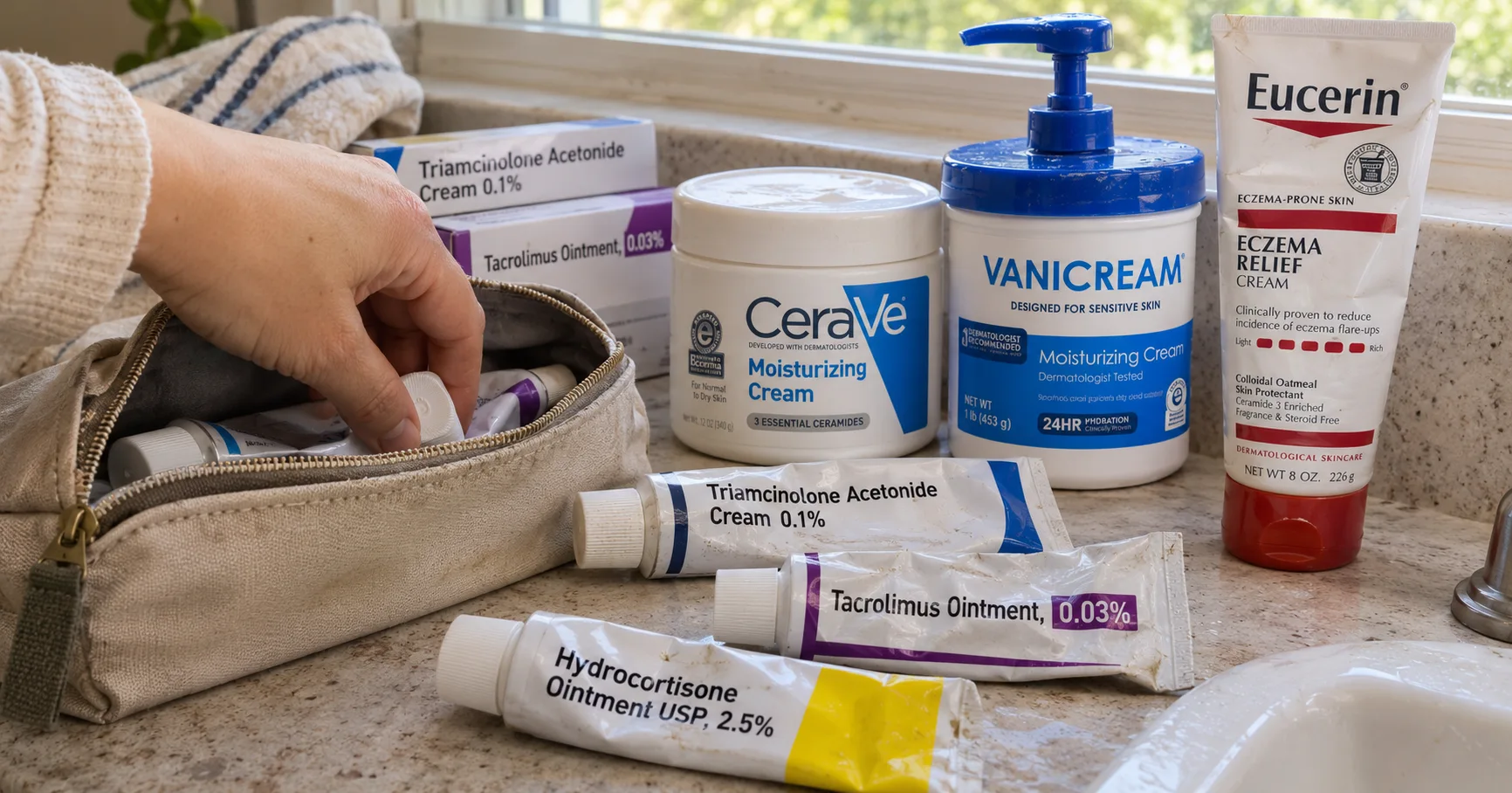
When skin care alone is not enough, there are more prescription options for children than ever. Your child's dermatology provider will choose based on your child's age, the areas affected, and how severe the eczema is.
Medicines applied to the skin
- Topical corticosteroids are used for children and adults. The strongest (ultra-high potency) steroids are for adults (National Eczema Association).
- Crisaborole ointment: ages 3 months and older (National Eczema Association).
- Tacrolimus ointment and pimecrolimus cream: ages 2 and older (National Eczema Association).
- Ruxolitinib cream: ages 2 and older, after the FDA approved it for children 2 to 11 in September 2025 (Contemporary Pediatrics).
- Tapinarof cream: ages 2 and older (Contemporary Pediatrics).
- Roflumilast cream: ages 2 and older, with a lower-strength cream for children 2 to 5 (Contemporary Pediatrics). The FDA is reviewing it for babies 3 to 24 months old, with a decision expected by February 23, 2027 (Contemporary Pediatrics).
For sensitive areas such as the face and eyelids, our dermatologists often prefer a nonsteroidal cream such as roflumilast, ruxolitinib, or tapinarof.
Injections and pills for moderate to severe eczema
- Dupilumab injections: ages 6 months and older (National Eczema Association).
- Tralokinumab, lebrikizumab, and nemolizumab injections: ages 12 and older (National Eczema Association).
- Upadacitinib pills: ages 12 and older, for eczema that is not controlled with other systemic medicines. Like other JAK inhibitor pills, it carries a boxed warning about serious risks, so your dermatologist will review the benefits, risks, and monitoring with you (National Eczema Association).
Injections and pills usually need approval from your insurance plan first, and our team works with your plan on these prior authorizations. Read our guide to prior authorization for dermatology medicines.
When to call
Contact your child's doctor or our office if you see (American Academy of Pediatrics):
- Yellow or honey-colored crusting and scabbing
- Weepy or oozy skin
- Blisters or pus bumps
- A rash that is not getting better with the usual treatments
If your child's eczema feels out of control, a call or an appointment with a dermatologist can help (American Academy of Dermatology).
Eczema care at our clinics
We see patients of every age at all three of our clinics. Same-week appointments are available, and we are in-network with all major insurance plans, commercial and government.
Anchorage
Our Anchorage clinic at 1100 E Dimond Blvd, Anchorage, AK 99515, serves families from Eagle River, Chugiak, and the rest of the Anchorage area.
Wasilla, Palmer, and the Mat-Su Valley
Our Wasilla clinic at 3066 E Meridian Park Loop, Wasilla, AK 99654, serves families from Palmer and across the Mat-Su Valley.
Juneau
Our Juneau clinic is inside Bartlett Regional Hospital Specialty Clinics at 3268 Hospital Drive, Juneau, AK 99801.
Learn more about eczema and atopic dermatitis care at our Alaska clinics.
We are here to help
Is eczema keeping your child up at night? Call us at (907) 267-5890 or request an appointment online.
Frequently asked questions

Scan to revisit this page
Point your phone camera here to reopen this guide anytime.
Medical disclaimer
This guide was prepared by the dermatology team at Advanced Dermatology of Alaska using information from the American Academy of Dermatology, the American Academy of Pediatrics, the National Eczema Association, and medical news reports of FDA approvals. Treatment approvals change, and this guide reflects information as of November 15, 2026. This guide is for general education and does not replace individualized medical care. For advice about your child's skin, contact your child's healthcare provider.
Selected references
- American Academy of Pediatrics, Section on Dermatology. Eczema in babies and children: symptoms and causes. HealthyChildren.org. Updated May 19, 2025.
- American Academy of Dermatology. Eczema: Tips to help your child feel better.
- American Academy of Dermatology. How can I keep my child's eczema under control?
- American Academy of Dermatology. Atopic dermatitis: Bleach bath therapy.
- National Eczema Association. Prescription topical treatments for eczema. Updated July 20, 2026.
- National Eczema Association. Injectable treatments for eczema. Updated June 30, 2026.
- National Eczema Association. Frequently asked questions: upadacitinib. Updated January 29, 2026.
- Contemporary Pediatrics. FDA approves ruxolitinib for pediatric patients with atopic dermatitis aged 2 to 11 years. September 2025.
- Contemporary Pediatrics. FDA approves tapinarof cream 1% for atopic dermatitis patients 2 years and up. December 16, 2024.
- Contemporary Pediatrics. FDA approves roflumilast cream 0.05% for atopic dermatitis for children 2 to 5 years. October 6, 2025.
- Contemporary Pediatrics. FDA accepts roflumilast sNDA for AD in infants aged 3 to 24 months. July 8, 2026.