
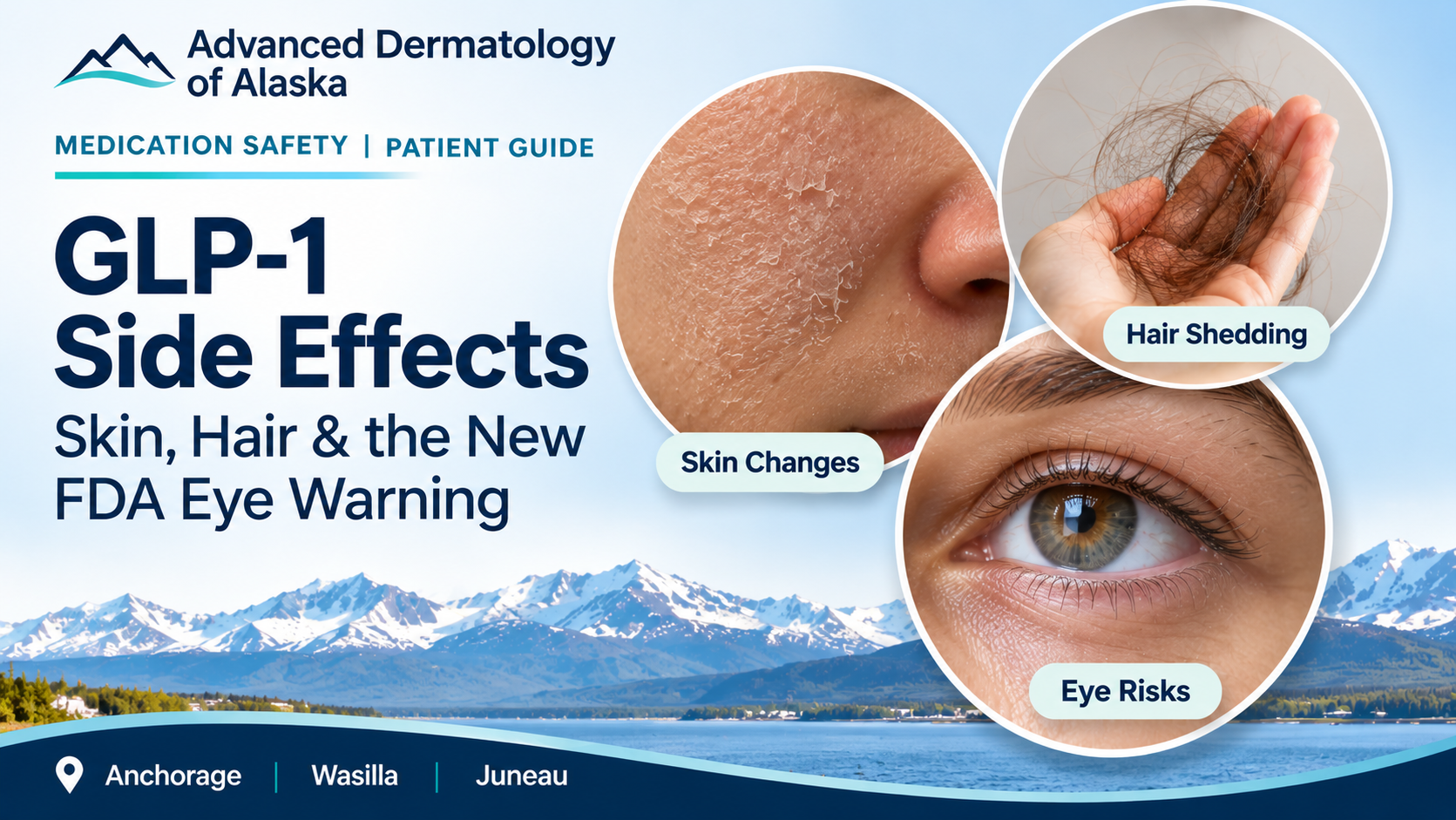
Medication Safety · Patient Guide
GLP-1 Side Effects: The New FDA Eye Warning and What to Know About Your Skin and Hair
The FDA now requires a warning about a rare but serious eye condition on every GLP-1 medicine. Here is what that means, plus the skin, hair, and nail changes dermatologists see most often, when to be concerned, and what can be treated.
By Advanced Dermatology of Alaska · November 12, 2026
Updated November 12, 2026, after the FDA's November 9 safety announcement. We will update this page as new information becomes available.
GLP-1 medicines, such as semaglutide and tirzepatide, have become some of the most widely used medicines for type 2 diabetes and weight management. On November 9, 2026, the FDA announced that every medicine in this class must add a warning about a rare but serious eye condition called NAION, which can cause sudden vision loss in one eye (FDA).
As dermatologists, we also see how these medicines can affect the skin, hair, and nails. Most of these changes are mild, many are temporary, and many can be treated. This guide explains the new eye warning, the skin and hair side effects that are most common, which symptoms need prompt care, and when a dermatologist can help.
The new FDA eye warning for GLP-1 medicines
On November 9, 2026, the FDA required the makers of all GLP-1 medicines to add information about a potential increased risk of nonarteritic anterior ischemic optic neuropathy (NAION) to the Warnings and Precautions section of their prescribing information. The warning covers every medicine in the class, including semaglutide (injections and tablets), tirzepatide, liraglutide, dulaglutide, exenatide, orforglipron, and combination products that contain liraglutide or lixisenatide (FDA).
What is NAION?
NAION happens when blood flow to the front part of the optic nerve, which carries signals from the eye to the brain, is reduced. It typically causes sudden, painless vision loss in one eye, which people may first notice when they wake up. The underlying cause is not completely understood. Risk factors may include smoking, diabetes, high blood pressure, sleep apnea, anemia, and kidney disease, and once NAION has affected one eye, the risk to the other eye is higher (FDA). The vision loss is sometimes permanent, and several of these risk factors are common in people who take GLP-1 medicines (Pharmacy Times).
How big is the risk?
NAION remains rare. When the FDA pooled 126 clinical trials with more than 134,000 participants, NAION occurred in about 6 of every 100,000 people per year of treatment with a GLP-1 medicine, compared with about 4 of every 100,000 people per year on placebo or other diabetes medicines. A separate FDA study of real-world data from adults with type 2 diabetes found a higher risk of NAION with GLP-1 medicines than with DPP-4 inhibitors, another type of diabetes medicine, but no clear increase compared with SGLT2 inhibitors. For context, NAION occurs in about 2 to 10 of every 100,000 adults over age 50 each year (FDA).
The FDA describes this as a potential increased risk, and its review did not identify how GLP-1 medicines might raise that risk (FDA). In Europe, regulators concluded in 2025 that NAION is a very rare side effect of semaglutide, which means it may affect up to 1 in 10,000 people who take it (European Medicines Agency). The concern drew wide attention in 2024, when a study from Massachusetts Eye and Ear found an association between semaglutide and NAION. Because it was an observational study, it could not prove cause and effect (JAMA Ophthalmology).
If you have diabetic eye disease
The prescribing information for semaglutide also notes that a rapid improvement in blood sugar can temporarily worsen diabetic retinopathy, and that people with a history of diabetic retinopathy should be monitored for it getting worse (semaglutide prescribing information). If you have diabetes, keep up with your regular eye exams.
Dermatologists do not diagnose or treat eye conditions. If your vision changes suddenly, contact an eye doctor right away or go to an emergency room.
GLP-1 medicines and your skin
GLP-1 medicines work in part by reducing appetite, and they can lead to significant weight loss. Some skin changes come from the medicine itself, such as reactions where it is injected. Others are linked to rapid weight loss, hormone changes, or eating and drinking less, which can leave the body short on the protein, vitamins, and nutrients that hair needs to grow (American Academy of Dermatology).
Most skin side effects are not dangerous, but they still matter. They can affect comfort, confidence, and whether people stay on a treatment that is helping their health. A few are signs of an allergic reaction that needs prompt care.
The most common skin, hair, and nail side effects
Injection site reactions
Redness, itching, swelling, or a small, firm bump can appear where the medicine is injected. In weight management trials, injection site reactions occurred in 1.4% of people taking semaglutide, compared with 1% on placebo, and in 6% to 8% of people taking tirzepatide, compared with 2% on placebo (semaglutide prescribing information; tirzepatide prescribing information). These reactions are usually mild and fade on their own. Rotating injection sites, as the instructions advise, can help.
Hair shedding
Hair loss is one of the most talked-about side effects. In clinical trials, it was reported by 3% of people taking semaglutide 2.4 mg and 6% of people taking the higher 7.2 mg dose, compared with 1% on placebo. In the 7.2 mg trials, it was reported by 8.4% of women but only 0.2% of men. With tirzepatide, it was reported by 4% to 5% of people, compared with 1% on placebo, and the prescribing information notes that it was associated with weight reduction (semaglutide prescribing information; tirzepatide prescribing information).
Dermatologists believe this hair loss is caused by rapid weight loss. Losing hair after a stressful event or a change in health is called telogen effluvium. GLP-1 medicines may also affect hair growth directly, and researchers need more information to say for sure why the hair loss happens (American Academy of Dermatology). Losing 20 pounds or more can trigger this kind of shedding. People typically notice it a few months after the trigger, and hair tends to regain its normal fullness within 6 to 9 months (American Academy of Dermatology). Researchers have also described pattern hair thinning (androgenetic alopecia) in some people taking these medicines, and women appear to be affected more often (Science Progress).
A burning, tingling, or sensitive skin feeling
Some people describe their skin as sore, tingly, or burning to the touch, a symptom called dysesthesia. In a trial of the higher 7.2 mg semaglutide dose, it was reported by about 23% of participants, compared with 6% on the 2.4 mg dose and less than 1% on placebo (Lancet Diabetes & Endocrinology). It has also been reported with tirzepatide and appears to be more common at higher doses. In reported cases, it often improved after the medicine was stopped (European Journal of Clinical Pharmacology). If this happens to you, tell your prescriber.
Changes in facial fullness and skin firmness
People taking these medicines have noticed less plumpness in the face, sagging skin, wrinkles, and a crepe-like texture, changes sometimes called "GLP-1 face." Dermatologists say rapid weight loss is part of the cause. As one dermatologist quoted by the American Academy of Dermatology put it, anyone who loses weight quickly notices changes in their face (American Academy of Dermatology).
Dry skin, brittle nails, and other changes
The American Academy of Dermatology also lists dry skin, slower nail growth and brittle nails, excessive sweating, and acne breakouts among the changes people may notice. After significant weight loss, loose skin that folds on itself can cause rashes where skin touches skin (American Academy of Dermatology).
Less common but more serious skin reactions
Allergic reactions to GLP-1 medicines are possible. In the tirzepatide weight management trials, hypersensitivity reactions were reported by 5% of participants, compared with 3% on placebo. Most were skin reactions such as rash and itching, and severe reactions occurred in 0.1% of people taking tirzepatide, compared with none on placebo (tirzepatide prescribing information). Serious allergic reactions, including anaphylaxis and angioedema (swelling under the skin), have been reported with medicines in this class (semaglutide prescribing information; tirzepatide prescribing information).
Rarely, case reports have described other skin reactions, including widespread drug rashes, blistering conditions such as bullous pemphigoid, and inflamed nodules in the fat under the skin (Archives of Dermatological Research). These need evaluation by a clinician.
When to see a dermatologist
Many skin changes on a GLP-1 medicine are mild and settle with simple care. Make an appointment with a dermatologist if you notice:
- Hair shedding that lasts longer than 6 months, comes out in patches, or comes with an itchy, scaly, or painful scalp
- Thinning that keeps getting worse, especially at the part or crown
- Injection site bumps that do not go away, keep coming back, or become painful
- A rash that spreads, lasts more than a week, or itches intensely
- Any blistering of the skin
- A burning or painful skin feeling that interferes with daily life (and tell your prescriber)
- Rashes in skin folds that keep returning
- New acne breakouts or excessive sweating
- Concerns about facial volume loss, sagging, or skin texture
- Psoriasis, hidradenitis suppurativa, or another chronic skin condition that changes after you start or stop a GLP-1
If you are prone to hair loss and plan to start a GLP-1 medicine, the American Academy of Dermatology suggests seeing a dermatologist first to diagnose the exact type of hair loss, and telling your dermatologist about your plans (American Academy of Dermatology).
What can be treated, and what is harder to fix
Usually improves or responds well to treatment
- Injection site reactions: rotating injection sites and a cool compress often help. Bumps that persist can be examined and treated.
- Hair shedding: shedding after weight loss is usually temporary (American Academy of Dermatology). Getting enough protein and nutrients matters, and the American Academy of Dermatology's guidance includes a standard daily multivitamin while taking a GLP-1 (American Academy of Dermatology). A dermatologist can look for other causes, such as thyroid problems or low iron, and recommend treatments that support regrowth, such as minoxidil, when appropriate. Learn more in our guide to understanding hair loss.
- Dry skin and brittle nails: a gentle cleanser, a moisturizer with ceramides applied while skin is still damp, a humidifier, and plenty of fluids can help (American Academy of Dermatology). Rubbing moisturizer into the nails and cuticles can also help brittle nails.
- Rashes in skin folds and acne: keeping skin folds clean and dry helps prevent irritation (American Academy of Dermatology), and prescription treatments can help with yeast rashes, irritation, and breakouts. See our acne treatment page.
- Wrinkles, crepey skin, and mild sagging: retinoids can help decrease signs of skin aging, though they can irritate skin that is already dry, and laser treatments can reduce wrinkles and tighten skin (American Academy of Dermatology). We offer laser treatments at our Anchorage and Wasilla clinics. Learn more about our cosmetic services.
- Allergic rashes and hives: these can be treated, and your prescriber can help decide whether to continue the medicine.
Harder to fix with skin treatments
- Lost facial volume: creams and lasers do not replace lost fat. Fillers or fat transfer can add volume back to the face (American Academy of Dermatology), and we can talk through options and referrals.
- Significant loose skin after major weight loss: skin care and lasers can improve skin quality, but substantial loose skin may need a surgical consultation.
- Skin sensitivity caused by the medicine itself: skin treatments do not fix it. In reported cases, it often improved after the medicine was stopped, but decisions about your dose belong to your prescriber (European Journal of Clinical Pharmacology).
- Vision loss from NAION: this is not a skin condition. Prompt evaluation by an eye doctor matters, because the vision loss is sometimes permanent (Pharmacy Times).
Whatever you notice, talk with the clinician who prescribes your GLP-1 medicine before stopping it or changing your dose, and get care right away for the vision or allergy warning signs above.
Skin conditions that may improve
Not every skin effect is a problem. Early research suggests GLP-1 medicines may help some inflammatory skin conditions (Diseases):
- Psoriasis: many patients taking these medicines report less itching and scaling, and weight loss and better blood sugar control have been shown to improve psoriasis and how well its treatments work (American Academy of Dermatology).
- Hidradenitis suppurativa: some patients report fewer flares, less drainage, less pain, and better quality of life, with the most benefit in those with obesity or type 2 diabetes (American Academy of Dermatology).
These findings are early. More studies are needed, including to learn whether the benefit comes from weight loss or from the medicines themselves (American Academy of Dermatology). If you have one of these conditions, keep taking your prescribed treatments unless your dermatologist advises a change. Learn more about psoriasis and hidradenitis suppurativa care at our clinics.
Protecting your skin and hair while taking a GLP-1
- Eat enough protein and nutrients. When you eat less, your body can run short of the protein, vitamins, and nutrients hair needs to grow. The American Academy of Dermatology's guidance also includes a standard multivitamin every day while taking a GLP-1 (American Academy of Dermatology).
- Ask about the pace of weight loss. If you are prone to hair loss, dermatologists advise losing weight slowly (American Academy of Dermatology). Your prescriber decides how your dose is adjusted.
- Moisturize daily. Use a gentle cleanser and a moisturizer with ceramides, applied while your skin is still damp after bathing, and drink plenty of fluids. A humidifier helps too; clean it regularly to prevent mold (American Academy of Dermatology).
- Protect your skin from the sun year-round. Use a broad-spectrum, water-resistant sunscreen with SPF 30 or higher on all skin not covered by clothing (American Academy of Dermatology).
- Rotate injection sites, following the instructions that came with your medicine.
- Keep skin folds clean and dry to prevent irritation where skin touches skin (American Academy of Dermatology).
- Know the vision warning signs listed above (FDA), and if you have diabetes, keep up with your regular eye exams.
- Check before you stop anything. Talk with your dermatologist before stopping a skin treatment (American Academy of Dermatology), and with your prescriber before stopping or changing your GLP-1 medicine.
GLP-1 skin and hair concerns in Anchorage, Wasilla, or Juneau
Advanced Dermatology of Alaska has clinics in Anchorage, Wasilla, and Juneau. Our board-certified dermatologists and SDPA Dermatology Trained physician assistants care for hair shedding, rashes, injection site reactions, acne, and chronic conditions such as psoriasis and hidradenitis suppurativa. We also offer cosmetic treatments, including laser treatments at our Anchorage and Wasilla clinics. Same-week appointments are available, and we are glad to coordinate with the clinician who prescribes your GLP-1 medicine.
We do not treat eye conditions. If you notice sudden vision changes, contact an eye doctor right away or go to an emergency room.
We are here to help
Noticing hair shedding, a rash, or other skin changes while taking a GLP-1 medicine? Call us at (907) 267-5890 or request an appointment online.
Frequently asked questions

Scan to revisit this page
Point your phone camera here to reopen this guide, including the vision warning signs, anytime.
Medical disclaimer
This guide was prepared by the dermatology team at Advanced Dermatology of Alaska using information from the FDA, the European Medicines Agency, the American Academy of Dermatology, prescribing information, and published research. It is for general education and does not replace individualized medical care. Safety information can change; this page reflects information as of November 12, 2026. For advice about your own symptoms or medicines, contact your healthcare provider. For vision changes, contact an eye doctor or seek emergency care right away.
Selected references
- U.S. Food and Drug Administration. FDA Requires Safety Labeling Changes for Glucagon-Like Peptide-1 Receptor Agonists (GLP-1 RAs) Due to Potential Increased Risk of Rare But Serious Eye Condition. Drug Safety Communication. November 9, 2026.
- Pharmacy Times. FDA Requires Class-Wide GLP-1 RA Labeling Changes for Potential NAION Risk. November 9, 2026.
- European Medicines Agency. Meeting highlights from the Pharmacovigilance Risk Assessment Committee (PRAC), 2 to 5 June 2025. June 6, 2025.
- Hathaway JT, Shah MP, Hathaway DB, et al. Risk of nonarteritic anterior ischemic optic neuropathy in patients prescribed semaglutide. JAMA Ophthalmol. 2024;142(8):732-739.
- Semaglutide injection and tablets for weight management: prescribing information. U.S. Food and Drug Administration. Revised May 2026.
- Tirzepatide injection for weight management: prescribing information. U.S. Food and Drug Administration. Revised March 2024.
- Wharton S, Freitas P, Hjelmesæth J, et al. Once-weekly semaglutide 7.2 mg in adults with obesity (STEP UP): a randomised, controlled, phase 3b trial. Lancet Diabetes Endocrinol. 2025;13(11):949-963.
- American Academy of Dermatology. How can GLP-1 drugs affect my skin, hair, and nails? Updated February 17, 2026.
- American Academy of Dermatology. Do you have hair loss or hair shedding?
- Gupta AK, Teasell EM, Economopoulos V, et al. GLP-1 therapies and hair loss: a systematic review of current evidence and implications for counseling. Sci Prog. 2026;109(2).
- Laroche ML, Géniaux H, Jardou M. Dysesthesia associated with GLP-1 agonist therapies: data-mining analysis and literature review. Eur J Clin Pharmacol. 2026;82(6).
- Salazar CE, Patil MK, Aihie O, et al. Rare cutaneous adverse reactions associated with GLP-1 agonists: a review of the published literature. Arch Dermatol Res. 2024;316(6):248.
- Persson C, Eaton A, Mayrovitz HN. A closer look at the dermatological profile of GLP-1 agonists. Diseases. 2025;13(5).