
Public Health Update · Patient Guide
Monkeypox (Mpox) in Alaska: What to Know About the Anchorage Cases
Four monkeypox cases have been reported in Anchorage this fall, including Alaska's first clade I cases. Here is what the rash looks like, how it spreads, when to get tested, who should get vaccinated, and what to do before you visit a clinic.
By Advanced Dermatology of Alaska. · November 10, 2026
Updated November 10, 2026, with the latest information from the Alaska Department of Health and CDC. We will update this page as public health officials share new information.
Alaska health officials are investigating four reported cases of monkeypox (mpox) in Anchorage. None of the people involved reported recent travel outside Alaska, and the source of infection is still under investigation. Two of the cases are the first clade I monkeypox cases reported in Alaska (Alaska Department of Health; Alaska Beacon).
Most people with monkeypox recover at home within two to four weeks (CDC). It is still worth understanding: it can be painful, it spreads through close contact, and a vaccine can help prevent it. As dermatologists, we know monkeypox can look like many other rashes, so knowing when to call, and how to arrive at a clinic safely, matters.
This guide explains what is known so far, which symptoms to watch for, how testing and vaccination work, and what to do if you have a new rash or a possible exposure.
Monkeypox in Alaska: what is happening
On October 29, 2026, the Alaska Department of Health alerted clinicians to three confirmed monkeypox cases in Anchorage. All three patients were men, none reported travel outside Alaska, and investigators found a link only between the first two. Those two cases were clade Ib, the first clade I monkeypox cases reported in Alaska; the third case's clade was still being determined. One patient was briefly hospitalized, and all three were isolating and recovering (Alaska Department of Health).
In early November, state officials learned of a fourth case, also in an Anchorage man who reported no recent travel outside Alaska. Two of the four patients are partners, and officials are still working to find the source of infection (Alaska Beacon).
A CDC epidemiologist working with the state cautioned that the lack of travel does not necessarily mean the virus is circulating in Alaska; these cases may be at the end of a chain of transmission (Alaska Beacon). All of the reported cases are in Anchorage.
For context, Alaska recorded five monkeypox cases during the 2022 global outbreak and two from 2023 through 2025, and those earlier cases were linked to travel (Alaska Beacon).
Across the country, clade I monkeypox has been spreading in a new way. Since August 2026, a growing share of U.S. clade I cases have been in people with no recent international travel, and CDC now reports presumed local spread in 16 U.S. jurisdictions. CDC expects more cases, but it considers the risk to most people in the United States to be low (CDC).
What is monkeypox (mpox)?
Monkeypox, also called mpox, is a viral illness caused by the monkeypox virus, a relative of the virus that causes smallpox. Both names refer to the same disease: CDC currently uses monkeypox, and the Alaska Department of Health uses mpox (CDC; Alaska Department of Health). It has two main types, called clades. Clade II caused the global outbreak that began in 2022. Clade I has historically caused more severe illness, but most recent clade I cases in the United States have been relatively mild, and CDC reports no deaths among the travel-related U.S. cases (CDC; Alaska Department of Health). Severe illness can still happen, especially in people with weakened immune systems (Alaska Department of Health).
Monkeypox symptoms and what the rash looks like
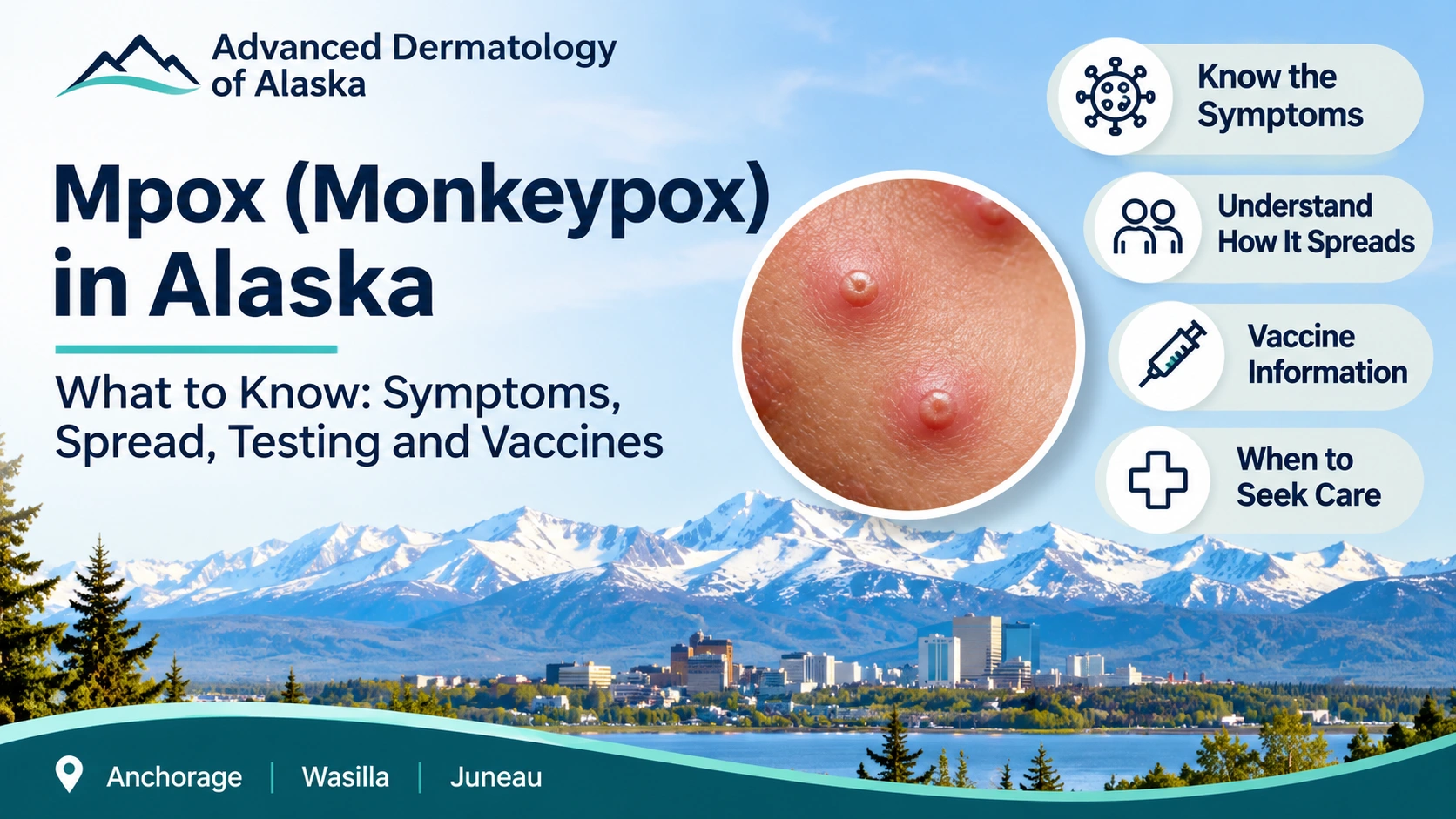
The most recognizable sign is a rash. It often begins as bumps that look like pimples or blisters, which can be painful or itchy. The spots then go through several stages, including scabs, before healing (CDC). The rash can appear on the face, inside the mouth, on the hands, feet, or chest, or on or near the genitals and anus. Some people have only one or a few sores, while others have many (CDC; CDC clinical guidance).
Other symptoms can include:
- Fever and chills
- Swollen lymph nodes
- Exhaustion, muscle aches, and backache
- Headache
- Sore throat, nasal congestion, or cough
These flu-like symptoms often start one to four days before the rash, but not always. Some people have the rash without any other symptoms (CDC; Alaska Department of Health). Symptoms typically begin 3 to 17 days after exposure, and they usually start within 21 days (CDC clinical guidance; CDC).
Monkeypox can resemble other rashes, such as herpes or chickenpox, so a lab test is needed to confirm it (Alaska Department of Health).
How monkeypox spreads
Anyone can get monkeypox through close, personal contact with someone who has it (CDC). It spreads through:
- Direct contact with the rash, scabs, or body fluids of a person with monkeypox
- Intimate and sexual contact, including oral, anal, and vaginal sex, as well as kissing, hugging, and massage
- Prolonged face-to-face contact with saliva or respiratory secretions
- Bedding, towels, clothing, or sex toys used by someone with monkeypox that have not been cleaned
- Pregnancy, from a pregnant person to the fetus, or to a newborn during or after birth
Monkeypox is not known to spread through the air across rooms, or in classrooms, offices, or during travel, and pools and hot tubs have not been linked to spread (CDC). Spread through brief, casual contact, such as passing someone in a store, has not been documented (Alaska Department of Health).
A person can spread monkeypox from the time symptoms start until the rash has fully healed and a fresh layer of skin has formed, typically two to four weeks. Some people may spread it one to four days before symptoms appear (CDC; Alaska Department of Health).
Condoms do not fully prevent monkeypox, because sores can appear on skin a condom does not cover (Alaska Department of Health).
In the United States, most recent clade I cases have been among gay, bisexual, and other men who have sex with men (CDC). That pattern helps public health officials focus vaccination and outreach. It does not mean other people cannot get monkeypox.
What to do if you have a new rash or were exposed
If you have a new, unexplained rash, sores, or blisters, especially after close or intimate contact with someone who has monkeypox or a similar rash, call a healthcare provider before you visit so the clinic can prepare for your visit safely (Alaska Department of Health).
While you wait to be seen or for test results
- Stay home, and avoid close physical and sexual contact with others.
- Cover sores with clothing, gauze, or bandages.
- Wear a well-fitting mask around other people.
- Do not share bedding, towels, clothing, utensils, or cups.
- Avoid contact with pets.
- Do not pop or scratch the sores.
These steps follow guidance from the Alaska Department of Health and CDC (Alaska Department of Health; CDC).
Monkeypox testing in Alaska
Testing is recommended for people who have a rash that looks like monkeypox (CDC). A clinician rubs swabs firmly across more than one sore and sends them to a lab. It can be uncomfortable, but it is needed to collect enough material for testing. Results are usually available within a few days. Tests done by public health departments are usually free, but tests sent to a commercial lab or done in a hospital may involve a fee (CDC).
In Alaska, monkeypox testing is available through the Alaska State Public Health Laboratory and select commercial labs (Alaska Department of Health). If you were exposed but do not have a rash, testing is generally not recommended (CDC). Instead, ask a healthcare provider about the vaccine and watch for symptoms (CDC).
If you are diagnosed with monkeypox
Most people recover in two to four weeks with care at home (CDC). Stay home and away from others until every sore has healed, the scabs have fallen off, and a fresh layer of skin has formed (Alaska Department of Health; CDC).
Comfort care at home
- For pain, acetaminophen or ibuprofen can help, and your clinician can prescribe something stronger if needed.
- For itching, an oral antihistamine, calamine lotion, petroleum jelly, or a warm oatmeal bath may help.
- For mouth sores, rinse with salt water.
- Do not pop sores, scratch the rash, or shave over it until the scabs have fallen off and new skin has formed.
These tips follow CDC guidance (CDC).
Protecting others
- Tell recent sexual partners and close contacts so they can get advice and, if eligible, the vaccine (Alaska Department of Health).
- Clean and disinfect the spaces you use regularly, especially shared bathrooms, and do not shake out soiled laundry or bedding (CDC).
- Ask someone outside your home to care for your pets until you recover (CDC).
There is no antiviral medicine approved by the FDA specifically for monkeypox, and most people get better with supportive care. For people who have, or are at high risk of, severe illness, an antiviral called tecovirimat is available through a CDC program coordinated with public health (Alaska Department of Health; CDC clinical guidance).
Who is at higher risk of severe illness
According to CDC, people at higher risk of severe monkeypox include:
- People with a severely weakened immune system, such as from uncontrolled HIV, certain cancers, an organ transplant, or medicines that weaken the immune system, like chemotherapy or some steroids
- People with active skin conditions, such as atopic dermatitis (eczema), psoriasis, or Darier disease
- People who are pregnant or were recently pregnant
- Children younger than 1 year
(CDC)
Why skin conditions matter. Eczema and other conditions that break down the skin's protective barrier put people at particular risk of the virus spreading out of control, which can cause serious illness (CDC clinical guidance). If you have eczema or psoriasis, contact a clinician promptly if you develop a new rash or have an exposure. Learn more about eczema and psoriasis care at our clinics.
The monkeypox vaccine in Alaska
A two-dose vaccine helps protect against monkeypox, and it is expected to protect against both clade I and clade II (CDC clinical guidance). It is recommended for people at higher risk and after an exposure, not routinely for everyone (CDC).
How the vaccine works
- Two doses are given 28 days (four weeks) apart. If your second dose is late, get it as soon as you can (CDC).
- If you received only one dose, even years ago, Alaska health officials advise completing the series (Alaska Department of Health).
- Protection is strongest about two weeks after the second dose. Two doses are estimated to be 66% to 90% effective (CDC clinical guidance).
- No vaccine is 100% effective, but if a vaccinated person does get monkeypox, the vaccine may help protect against severe illness (CDC).
- The most common side effects are pain, redness, and itching where the shot was given (CDC).
- The vaccine prevents monkeypox. It is not expected to help once symptoms have started (CDC clinical guidance).
Who should get the vaccine
CDC recommends the vaccine for people who:
- Have had a known or suspected exposure to someone with monkeypox
- Had a sex partner in the past two weeks who was diagnosed with monkeypox
- Are gay, bisexual, or other men who have sex with men, or transgender or nonbinary people, and in the past six months had a new sexually transmitted infection, more than one sex partner, sex at a commercial sex venue, sex related to a large commercial event, or sex in an area where monkeypox is spreading
- Have a sex partner with any of these risks, or expect to be in any of these situations
- Are traveling to a country with a clade I monkeypox outbreak and expect sex with a new partner, sex at a commercial sex venue, sex in exchange for money or goods, or sex at a large public event
- Work in certain laboratory or healthcare roles with a risk of exposure
(CDC)
The vaccine is licensed for adults 18 and older. People younger than 18 who are at high risk can receive it under an emergency authorization, before or after an exposure. It can also be offered during pregnancy and breastfeeding after a discussion with your clinician (CDC clinical guidance).
Where to get the vaccine in Alaska
- In Anchorage, call the Anchorage Health Department at (907) 343-4799 to check availability and schedule.
- Elsewhere in Alaska, the Alaska Section of Epidemiology at (907) 269-8000 can help you find vaccine.
- You can also ask your healthcare provider or local pharmacy.
- To check whether you received a dose in the past, look up your Alaska vaccination record through Docket.
(Alaska Department of Health; CDC)
Rash concerns in Anchorage, Wasilla, or Juneau? Call us first
Advanced Dermatology of Alaska has clinics in Anchorage, Wasilla, and Juneau. We care for patients with rashes and other medical skin conditions at all three clinics. If you have a new rash or sores and think monkeypox is possible, please call us at (907) 267-5890 before you come in, rather than booking online or walking in. Our team will ask about your symptoms and advise you on the safest next step.
If you have severe symptoms outside office hours, seek urgent or emergency care, and call ahead to let them know you may have monkeypox.
We are here to help
Questions about a rash or another skin concern? Call us at (907) 267-5890. If you think you may have monkeypox, please call before you come in so we can guide you.
Serving Wasilla, Palmer, Anchorage, Juneau & the Mat-Su Valley
Frequently asked questions

Scan to revisit this page
Point your phone camera here to reopen this guide, including the testing and vaccine contacts, anytime.
Medical disclaimer
This guide was prepared by the dermatology team at Advanced Dermatology of Alaska using information from the Alaska Department of Health and CDC. It is for general education and does not replace individualized medical care. Outbreak information can change quickly; this page reflects information as of November 10, 2026. For advice about your own symptoms or exposure, contact your healthcare provider.
Selected references
- Alaska Department of Health. Three Cases of Mpox: Anchorage, October 2026. Alaska Public Health Alert Network. October 29, 2026.
- Rosen Y. New outbreak of mpox in Anchorage prompts advisory from state health officials. Alaska Beacon, November 6, 2026; republished by Alaska Public Media, November 9, 2026.
- Centers for Disease Control and Prevention. Global Monkeypox: Current Situation. Updated November 2, 2026.
- Centers for Disease Control and Prevention. Signs and Symptoms of Monkeypox. January 22, 2026.
- Centers for Disease Control and Prevention. Clinical Signs and Symptoms of Monkeypox. January 14, 2026.
- Centers for Disease Control and Prevention. How Monkeypox Spreads. February 23, 2026.
- Centers for Disease Control and Prevention. Getting Tested for Monkeypox. January 23, 2026.
- Centers for Disease Control and Prevention. What to Do If You Are Sick. January 26, 2026.
- Centers for Disease Control and Prevention. If You're a Close Contact. January 22, 2026.
- Centers for Disease Control and Prevention. Monkeypox Vaccination. January 22, 2026.
- Centers for Disease Control and Prevention. Vaccine for Monkeypox Prevention in the United States. September 4, 2026.
- Centers for Disease Control and Prevention. Caring for Patients with Monkeypox. January 15, 2026.